In the 1920s houses were built on the 'Wageningschen Berg', the area adjacent to Rijksstraatweg (now Generaal Foulkesweg), creating the Hamelakkers district. Soon everyone calls this district 'the Sahara' because the soil is so bad. During the war, many inhabitants of the Sahara take people in hiding into their homes.
Sunday September 17, 1944 is a clear warm day. People are sitting in their gardens, are out visiting or have gone to church, children are playing outside.
On that same September 17, around 13:30, Operation Market Garden will commence: the Allies want to conquer strategic bridges on Dutch territory with airborne troops. But first the German anti-aircraft guns must be eliminated. It is suspected that such an artillery is located near the Lexkesveer.
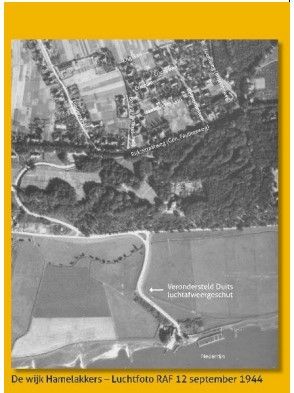
The Hamelakkers district Aerial photo RAF 12 September 1944
Eyewitness account
From a report by Henk Glimmerveen, 11 years old at the time and living on Diedenweg: suddenly I saw that a few planes were flying lower than the rest. Immediately afterwards I saw bombs fall, black streaks whizzing down against the blue sky. Without thinking, I dropped to the ground. I was already down when I saw the last bombs come down very close. My next memory is a cloud of dust, so dense that I could only see a few meters at the most.”
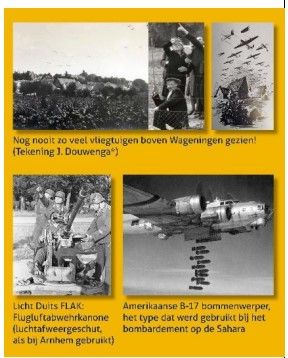
Never seen so many planes over Wageningen! (Drawing J. Douwenga") 160 shrapnel bombs fall on the district. 35 residents, including 1 Jewish woman in hiding, are killed almost immediately, hit by bombs, shards and debris. 4 of the 14 seriously injured later die from their injuries. 1 person is and remains missing. 28 houses are in ruins or damaged.Light German FLAK: Flugluftabwehrkanone (anti-aircraft gun, as used at Arnhem) American 8-17 bomber of the type used in the bombing of the Sahara.
How could this have happened?
The American bombers that were used were not suitable for precision bombing. The course just before the bombs were dropped had not been calculated correctly and the guide plane's autopilot CHECK THIS failed. The navigation equipment was difficult to operate and the crew possibly was inexperienced. The result was that the bombs landed 'a little to the north' of the target: 800 meters out of the way, on top of the Hamelakkers district.
The bombing of the Sahara has long been called 'the forgotten bombing', because there has never been an official commemoration. On September 17, 2019, exactly 75 years after the disaster, at the initiative of current inhabitants of the Sahara a monument was unveiled on Erica Square, in memory of the victims.
On the following banners we show some aspects of life in the Sahara during the war and about the horrors of the bombing, based on stories about some of the residents.
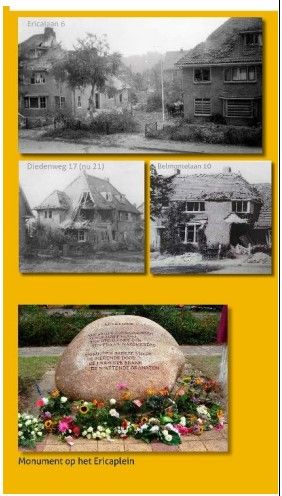
Diedenweg 17 (now 21)
Belmontelaan 10
Monument on Ericaplein