How did I experience the war years
My name is Hendrik Jan Roskam and I was born on 16th April 1933 in Wageningen. I lived at Haagsteeg 5 together with my father Willem, mother Janna van Roest, older brother Jaap, my little brother Willem plus a cat and our dog Sunny. I have drawn my house and other buildings on these banners.
The house was located on the grounds of the National experimental garden of the Agricultural College, where my father was the caretaker. North of our house was the laboratory of the National Garden. South of our house was the Maritime engineering testing station, now known as Marin, with its long towing tank (water basin).
In 1939 the Dutch army commandeered the kindergarten on the Dijkstraat, where I used to go as a 4-year-old. I moved to the kindergarten at the Veluviaweg, which further away from home. This was a temporary solution, because a new school was already being built on the Eekmolenweg, where the new Patrimonium district wasbuilt. Many young families with children moved there.

I was 7 years old when the war started. In the early morning of the 10th May 1940 the skies were black with planes. At first my father thought it was an army exercise, but there were too many airplanes. Germany invaded the Netherlands.
The Netherlands had built the Grebbelinie: a defence line from the Betuwe via the Grebbeberg and Veenendaal in the direction of Amersfoort. Since Wageningen was in the range of fire, the city and surrounding area needed to evacuate. My father was a member of the city council of Wageningen. He needed to warn all the people in our block that they should go to the harbour in the afternoon. In the harbour were boats that would transport civilians to IJsselmonde, near Rotterdam. At night we sailed towards Rotterdam. The next morning we saw large plumes of smoke above Rotterdam: the city centre was destroyed by German bombers. We couldn't go to IJsselmonde. Finally we ended up in Streefkerk, a place on the Lek, where we stayed until we were allowed to return to Wageningen.

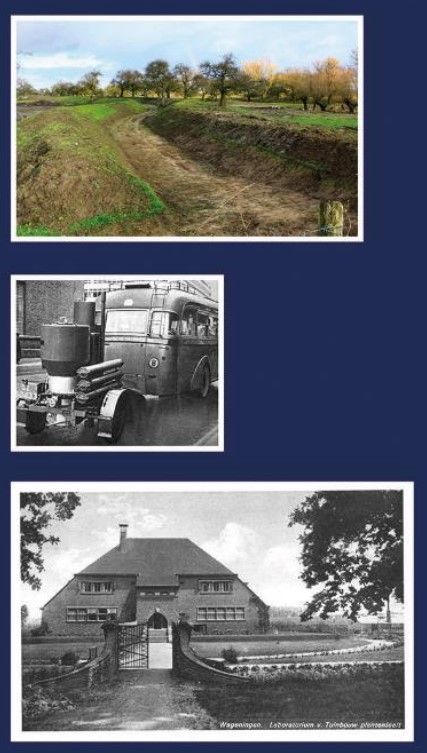
In the summer of 1940 we swam in a tank trap in the meadows near Wageningen. A tank trap is a kind of channel of 80 to 100 meters long
and 5 to 6 meters wide. At a distance of 8 to 10 meters they were
invisible to a tank so they dived into it at full speed. The traps were dug
during the crisis years by the unemployed on benefits. They had no
machines, only a wheelbarrow and a shovel. (In the photo a tank trap
elsewhere in the country.)
In the second half of 1941, fuel such as coal and gas was becoming increasingly scarce. To be able to cook and to keep warm we had to collect wood. Copper had to be handed in, such as decorative pots and cups, to manufacture shells for grenades. Hitler's promise that things would improve, did not materialise.
I remember that half of the Van Roest family from Renkum came to peel apples with us in the living room at the big table. My father arranged a few boxes of apples and the whole family peeled their fingers blue, but it was quite good fun! My father took pillow cases full of peeled apples to the Lab, to the dryer. Dried apples can be stored longer. They were later shared with the 'peeling family'. Chickens in the run behind the house provided the necessary eggs.