By Roskam
It became quiet in the house after this hectic time: my father was gone, Bert and Mrs. Roth had fled and the five people in hiding had been taken away. We never heard from those five people again.
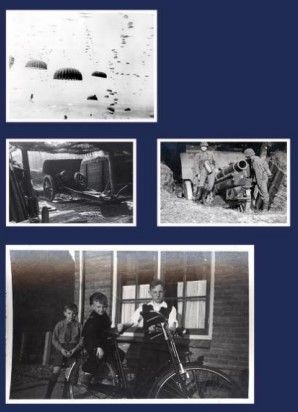
In September 1944 the airborne troops landed on the Ginkelse Heide.
On Sunday morning 17th September English fighter planes threw stuffed tinfoil down around the radar installation at the airport in Deelen to sabotage it. We felt that something was going to happen and that soon became reality.
Around Wageningen, heavy artillery was used again. We were allowed to stay in Wageningen, but those few weeks were no fun. We slept in the basement and around noon we heard grenades explode. It was life-threatening to go out, we could not go shopping.
The Germans had a weapon that fired multiple grenades at the same time and the noise really startled us. The Allies across the Rhine fired back every time. Between the shelling it was pretty quiet. Because of all the noise we thought everything would have been flattened, but every day we were surprised it was not that bad. One day I was playing behind the house when suddenly I heard a shrill
whistle, followed by a loud bang: a few hundred meters away from me a grenade had exploded! It became too dangerous to stay at home.
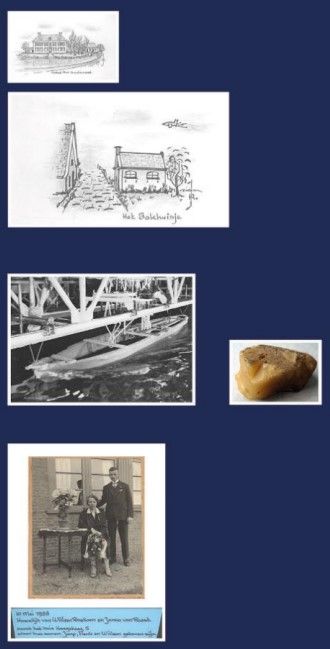
This time we didn't leave Wageningen by boat, but on foot. Our suitcases containing as much food as possible luckily could go on the cart of butcher Roelofsen. We walked down the Rijnsteeg in a line, through the Kraats, in the direction of De Klomp, via Renswoude to Woudenberg. We stayed overnight with a farmer in his hayloft. The next day we continued towards Austerlitz, Zeist and Bunnik. Everywhere was full and we walked on towards Utrecht. In the end we were able to stay at castle (country house) Oud Amelisweerd.On the return trip to Wageningen we could stay at the bakery on Krommesteeg. It was a small house, but we got by very well. Farmer Huisman allowed us to use his firewood. There was no electricity.
The Maritime station staff had given us a chunk of paraffin wax to make candles. Paraffin was used to make small ship models, which were used to do sea trials
in a large water tank. To make candles we ran a piece of cotton thread through an iron conduit and we stretched the string with a piece of wood at the top. We
turned the paraffin to liquid by heating it on the stove and poured it into the tube. When the paraffin solidified, we rolled the tube over the warm stove. After a while we were able to remove the paraffin from the tube and we had a nice candle.